

[Southeast University News Network, April 23] (Correspondent: Xiong Ren’gen) Recently, the research team of Prof. You Yumeng from the International Institute of Molecular Ferroelectricity Science and Application of School of Chemistry and Chemical Engineering & Jiangsu Provincial Key Laboratory of “Molecular Ferroelectricity Science and Application” has achieved important progress in the research of molecular ferroelectric directional design. The team synthesized the first proton transfer DABCO-based ferroelectric. Related achievement was published in the Journal of the American Chemical Society, the top journal in the field of Chemistry, with the title of “Bistable State of Protons for Low-Voltage Memories”.
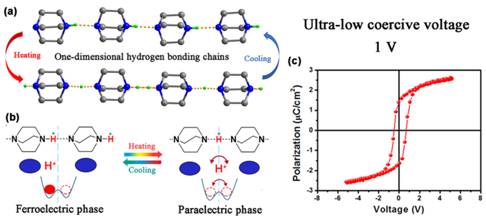
Fig. 1. (a) [HDABCO] [TFSA] one-dimensional hydrogen-bonded chain at high temperature phase and low temperature phase respectively;(b) schematic diagram of [HDABCO] [TFSA] double-well potential energy along the one-dimensional hydrogen-bonded chain direction of high-temperature phase and low-temperature phase; (c) hysteresis loop
As ferroelectric materials have the spontaneous poles that can upset with the external electric field, they are widely used in the field of non-volatile memory. Low-power memories require ferroelectric materials to have a lower coercive voltage. In recent years, researchers have made great efforts in exploring the low-coercivity field molecular-based ferroelectrics, and thus discovered many excellent ferroelectrics. To date, those compounds based on spherical organic cations highlight the best performance, such as 1,4-diazabicyclo [2.2.2] octane (DABCO) and the quinine ring family. Their low rotational barriers enable them to have low coercive voltage. Including [HDABCO] [ClO4] and [HDABCO] [BF4] previously discovered by the team, the ferroelectricity of these materials is all derived from the order-disorder transition of cations or anions in the molecules.
In this study, the team modified the anion of bi-trimethyl sulfoacid by using the “toluene effect” to design and synthesize (trifluoromethylsulfonyl) ammonium acid 1,4-diazabicyclobis [2.2.2] octane: [HDABCO] [TFSA] and its deuterium: [DDABCO] [TFSA]. The study found that [HDABCO] [TFSA] features a 2/mF2 ferroelectric phase transition. Unlike other DABCO and quinine ring ferroelectrics, the ferroelectricity of [HDABCO] [TFSA] comes from the ordering of protons in hydrogen bonds (Fig. 1 (a)). The potential energy curve satisfies the soft phonon double-well potential model (Fig. 1 (b)). In the high-temperature phase, the protons with larger kinetic energy traverse more frequently between the two wells; thus the protons have almost the same probability in both wells and the crystal is in a disordered phase. In the low-temperature phase, the protons are much more likely to stay in one of the wells, so the crystal enters an ordered phase. In the ordered phase, the protons have to stride over relatively lower energy barriers for transfer; therefore, this ferroelectric mechanism enables [HDABCO] [TFSA] to have a lower coercive voltage (Fig. 1 (c)). However, the working temperature of [HDABCO] [TFSA] is lower than the room temperature, which has severely limited its application in devices. The researchers further obtained the deuterium of [HDABCO] [TFSA] based on the deuterium isotope effect: [DDABCO] [TFSA], and successfully raised the working temperature above the room temperature. Fig. 2 shows the change curve of the two dielectrics with temperature and the phase-transition temperatures are 274.3K and 327.4K respectively. Such great deuterium isotope effects (ΔT = ~ 53K) have further verified that these compounds are hydrogen-bonded ferroelectrics. This article provides a new insight for designing and synthesizing low-coercive voltage ferroelectrics, which will be beneficial to the application of molecular-based ferroelectrics in low-power storage devices.
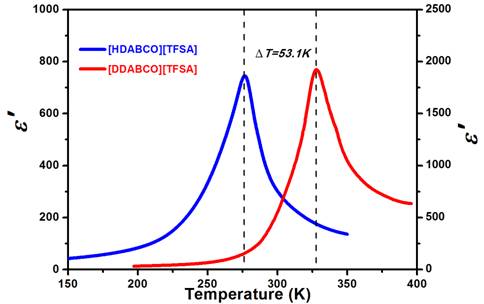
Fig. 2. [HDABCO] [TFSA] and [DDABCO] [TFSA] dielectric variation curve with temperature
This study was jointly accomplished by doctoral students Song Xianjiang, Zhang Zhixu and Chen Xiaogang, etc.. Southeast University is the sole completion institute and Prof. You Yumeng et al. are the corresponding authors. This achievement was supported by the “Cultivation Fund for the Top Ten Science and Technology Issues of Southeast University”.
Paper’s link: https://pubs.acs.org/doi/abs/10.1021/jacs.0c02924
Submitted by: School of Chemistry and Chemical Engineering
(Editor-in-charge: Ji Hong, reviewed by: Song Yechun)